
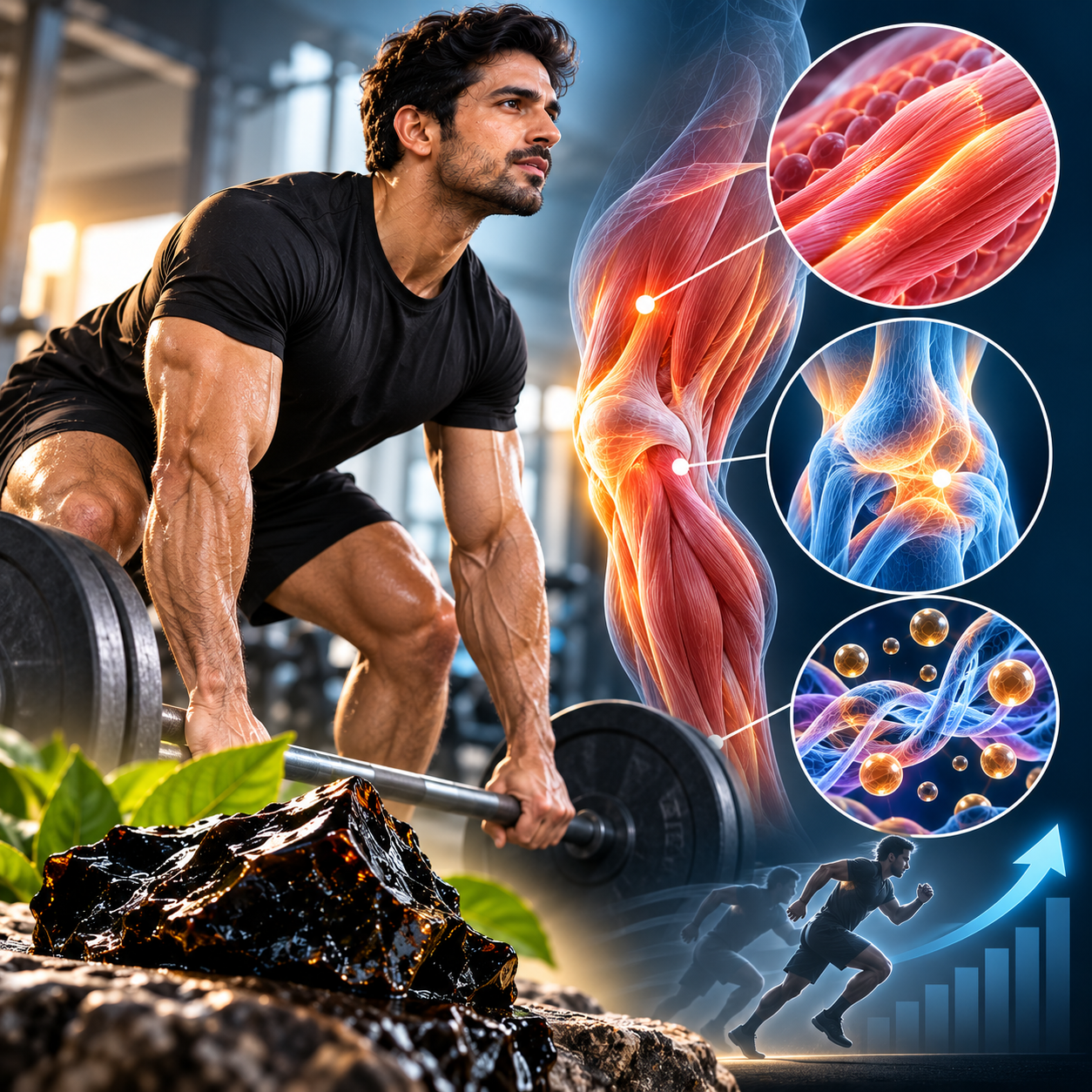
Shilajit and Human Health: What Does Clinical Research Really Show?
Shilajit and Human Health: What Does Clinical Research Really Show?
Shilajit has been used for centuries in traditional medicine, but modern research is increasingly examining whether its traditional uses are supported by human clinical evidence.
A 2025 review by Ashif Iqubal and Abdul Qadir, published in the International Journal of Basic & Clinical Pharmacology, brings together available clinical and safety evidence on Shilajit, while also discussing possible biological mechanisms identified in preclinical research. Int J Basic Clin Pharmacol
The review is particularly useful because it does not focus on a single health outcome. Instead, it examines research involving physical performance, fatigue, reproductive health, cardiovascular parameters, bone health, skin health and safety.
Shilajit: More Than Fulvic Acid
Shilajit is a complex herbo-mineral substance containing organic compounds and mineral components. According to the review, its composition can vary depending on geographical origin, environmental conditions, processing and purification.
Fulvic acid is one of its important constituents, but Shilajit also contains humic substances, minerals, trace elements and other bioactive compounds. Int J Basic Clin Pharmacol
This is important when interpreting research.
A clinical result obtained with one standardized Shilajit extract cannot automatically be applied to every Shilajit product available on the market.
For this reason, purification, standardization, identity, composition and quality testing are important considerations when evaluating Shilajit scientifically.
What Does Human Clinical Research Show?
The 2025 review summarizes a number of human studies. The evidence is promising in several areas, but the strength of evidence differs considerably between outcomes.
1. Shilajit and Testosterone
One of the better-known clinical studies reviewed by Iqubal and Qadir investigated purified Shilajit in healthy men aged 45–55 years.
Participants received 250 mg twice daily for 90 days in a randomized, double-blind, placebo-controlled study.
The researchers reported significant increases in:
- Total testosterone
- Free testosterone
- DHEAS
while LH and FSH remained relatively stable. Int J Basic Clin Pharmacol
These findings suggest that a particular purified Shilajit preparation may influence androgen-related biomarkers in this population.
However, this should not be interpreted as proof that every Shilajit product increases testosterone or that Shilajit is a treatment for testosterone deficiency.
2. Shilajit and Male Fertility
The review also discusses a randomized clinical study involving 28 men with oligospermia.
Participants received 100 mg of processed Shilajit twice daily for 90 days.
The study reported improvements in:
- Total sperm count
- Sperm motility
- Normally formed sperm
- Semen oxidative-stress markers
The review reports total sperm count increasing from approximately 14.3 million/mL to 23.1 million/mL, while sperm motility increased from approximately 25.1% to 42.5%. Int J Basic Clin Pharmacol
These results are interesting, but the study population was specifically men with low sperm counts. Therefore, the findings should not be generalized to all men or interpreted as proof that Shilajit can treat infertility.
3. Shilajit, Physical Performance and Fatigue
Clinical research has also investigated Shilajit in relation to physical performance and recovery.
The review describes research using standardized PrimaVie® Shilajit in adults with overweight or class-I obesity, where supplementation was associated with changes in genes involved in extracellular-matrix structure and muscle adaptation. Int J Basic Clin Pharmacol
Another clinical study reviewed by the authors found that 500 mg/day of Shilajit was associated with better retention of maximal voluntary isometric strength following a fatigue protocol compared with placebo and a lower-dose group.
The high-dose group showed an adjusted decline in MVIC of approximately 8.9%, compared with about 16–17% in the comparison groups. Int J Basic Clin Pharmacol
Importantly, these findings relate to specific preparations and study conditions. They do not establish Shilajit as a universal performance-enhancing substance.
4. Shilajit and Collagen
Another clinical study examined the effect of Shilajit supplementation on type I collagen synthesis.
Participants received either 500 mg/day or 1,000 mg/day of PrimaVie® Shilajit or placebo for eight weeks.
The study reported increased levels of pro-C1α1, a biomarker associated with type I collagen synthesis. The review reports clinically meaningful increases in a larger proportion of participants receiving Shilajit compared with placebo. Int J Basic Clin Pharmacol
Because collagen is an important structural protein in connective tissue, these findings provide a possible biological explanation for some of the research investigating Shilajit and musculoskeletal health.
However, a biomarker improvement should not automatically be interpreted as proof of improved clinical outcomes.
5. Shilajit and Bone Health
One of the longer clinical studies discussed in the review involved 60 postmenopausal women with osteopenia.
Participants received either placebo or 250 mg/day or 500 mg/day of standardized aqueous Shilajit extract for 48 weeks.
The study reported dose-related effects on bone mineral density, particularly at the lumbar spine and femoral neck. Changes were also observed in bone-remodeling markers including CTX-1, BALP, RANKL and OPG. Int J Basic Clin Pharmacol
The researchers also observed reductions in markers associated with oxidative stress and inflammation, including MDA and hsCRP, while glutathione increased.
This is one of the more interesting areas of Shilajit research because the study was relatively long compared with many short-term supplement studies.
Nevertheless, it involved a specific population and a standardized extract, so the results should not automatically be extended to all adults.
6. Shilajit and Cardiovascular Biomarkers
The review describes a 45-day placebo-controlled study in healthy volunteers receiving 2,000 mg/day of Shilajit.
According to the review, there were no significant adverse changes in vital signs or hematological parameters. The study also reported reductions in triglycerides, total cholesterol, LDL and VLDL, along with an increase in HDL and antioxidant markers. Int J Basic Clin Pharmacol
These findings are potentially interesting, but they should be regarded as early clinical evidence rather than proof that Shilajit prevents or treats cardiovascular disease.
7. Shilajit and Skin Health
The review also identifies clinical research investigating Shilajit in middle-aged women.
In a 14-week double-blind, placebo-controlled study, participants received 125 mg or 250 mg twice daily.
The higher dose was associated with changes in skin microperfusion and expression of genes involved in extracellular-matrix remodeling and vascular processes. Int J Basic Clin Pharmacol
These findings suggest another potential area for investigation, particularly around collagen and tissue structure.
More research is needed before translating these molecular findings into broad skin-health claims.
8. Shilajit and Bone Fracture Healing
A randomized, double-blind, placebo-controlled clinical trial involving 160 patients with acute tibial fractures is also discussed in the review.
Participants received either purified Shilajit at 1,000 mg/day or placebo for 28 days following surgery.
The reported average radiographic union time was approximately:
129 days with Shilajit vs. 153 days with placebo.
The difference reached statistical significance in the reported analysis, while adverse-event rates did not differ significantly between groups. Int J Basic Clin Pharmacol
This is an intriguing finding, but fracture healing is a medical issue requiring professional orthopedic management. Shilajit should not be considered a replacement for surgery, prescribed treatment or rehabilitation.
What About Safety?
Safety is one of the most important parts of the scientific discussion surrounding Shilajit.
The Iqubal and Qadir review summarizes both animal and human safety data. Some clinical studies reported good tolerability and no major changes in liver, kidney or cardiovascular safety markers under the studied conditions. Int J Basic Clin Pharmacol
At the same time, the authors acknowledge important limitations in the safety literature and specifically recommend avoiding Shilajit during pregnancy and lactation. Int J Basic Clin Pharmacol
Another important issue is product quality.
Because Shilajit’s composition can vary according to its source and processing, scientific evidence from one standardized preparation cannot automatically establish the safety or efficacy of another product. Int J Basic Clin Pharmacol
This makes purification, quality control and contaminant testing particularly important for products intended for human consumption.
The Most Important Scientific Takeaway
The 2025 review by Iqubal and Qadir provides a useful overview of the growing human evidence surrounding Shilajit.
The research suggests potential areas of interest including:
✓ Testosterone and androgen-related biomarkers
✓ Male reproductive parameters
✓ Physical performance and fatigue
✓ Muscle and connective-tissue adaptation
✓ Collagen synthesis
✓ Bone mineral density and bone turnover
✓ Oxidative-stress biomarkers
✓ Selected cardiovascular and metabolic markers
✓ Skin-related biological parameters
However, the evidence is not equally strong across all these areas.
Some studies are randomized and placebo-controlled, while others are small, open-label, product-specific or focused on biomarkers rather than clinical outcomes.
The authors themselves emphasize the need for better-designed and longer-term clinical research, particularly because Shilajit’s composition can vary between preparations. Int J Basic Clin Pharmacol
What This Means for HARSIVA
For HARSIVA, the most responsible way to communicate Shilajit research is to distinguish between scientific evidence and marketing claims.
Research should be presented according to:
- The exact Shilajit preparation studied
- The dosage used
- The duration of supplementation
- The population studied
- The study design
- The actual measured outcome
- The limitations of the research
A study conducted using purified or standardized Shilajit should not automatically be presented as clinical evidence for every Shilajit resin available commercially.
HARSIVA’s scientific positioning should therefore focus on quality, purification, transparency and evidence-informed communication, rather than promising specific medical outcomes.
Conclusion
Modern research is beginning to provide human clinical evidence for some of the traditional uses of Shilajit.
The 2025 review by Ashif Iqubal and Abdul Qadir brings together evidence from clinical trials examining areas such as reproductive health, testosterone, physical performance, collagen, cardiovascular biomarkers, skin health and bone health. Int J Basic Clin Pharmacol
The overall picture is promising—but it is still developing.
Shilajit should not be viewed as a universal treatment or as a substitute for medical care. Instead, it is better understood as a complex herbo-mineral substance whose potential biological effects are increasingly being investigated through modern clinical research.
For a science-focused brand such as HARSIVA, the strongest approach is simple:
Respect the traditional origin. Follow the modern evidence. Communicate the science responsibly.
Scientific Reference
Iqubal A, Qadir A. Clinical studies and safety evidence for human consumption of Shilajit: a herbo-mineral compound with multifaceted health benefits. International Journal of Basic & Clinical Pharmacology. 2025;14(4):630–640. DOI: 10.18203/2319-2003.ijbcp20251850. Int J Basic Clin Pharmacol
Read the original research review
SEO Details
SEO Title: Shilajit and Human Health: What Does Clinical Research Show?
Meta Description: Discover what modern clinical research says about Shilajit, including testosterone, male fertility, physical performance, bone health, collagen, cardiovascular markers and safety.
Focus Keyword: Shilajit clinical research
Secondary Keywords:
- Shilajit clinical studies
- Shilajit research
- Shilajit and testosterone
- Shilajit and male fertility
- Shilajit benefits research
- Shilajit safety
- Shilajit scientific evidence
- Shilajit human studies
Suggested URL Slug:
shilajit-clinical-research-human-health
Medical Disclaimer: This article is for educational and informational purposes only. It summarizes published scientific research and does not constitute medical advice, diagnosis or treatment. Individual studies may involve specific Shilajit preparations, doses and populations that cannot necessarily be generalized to all Shilajit products.
Leave a Reply